
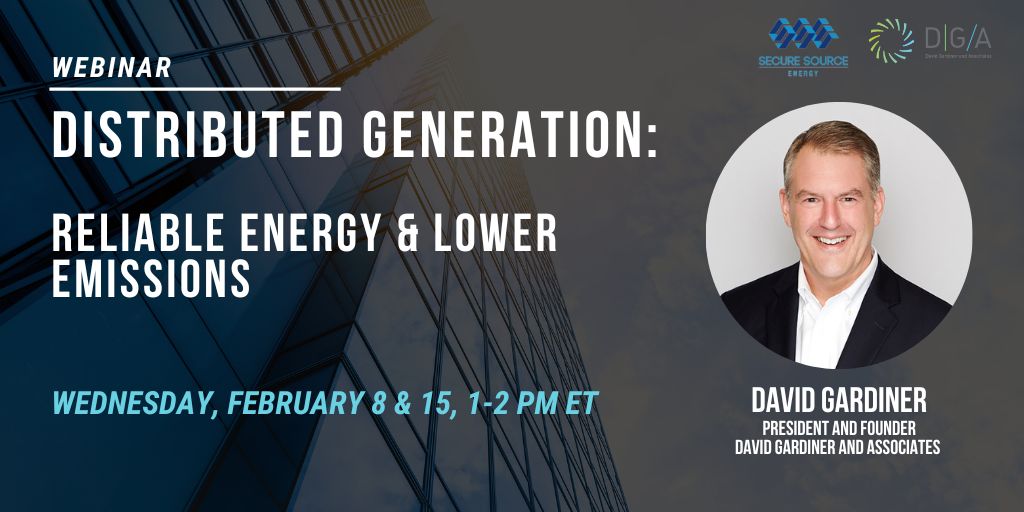
DGA co-hosted a series of two webinars with Secure Source Energy exploring the benefits of distributed trigeneration and its diverse potential uses. 

Trigeneration systems produce electricity while also providing heating and cooling. A distributed trigen system is non-utility scale energy generation located at or near the site where it’s consumed. While typical electric generation loses about 5% of its energy in the distribution and transmission process, these on-site systems experience only minimal losses because the energy is generated close to where it’s used.

Trigen systems are immediately deployable and can help enhance building efficiency; improve reliability in the face of ever-increasing extreme weather threats, and reduce carbon emissions. Our webinar will examine the many practical uses of trigen — and dive into new tax incentives in the Inflation Reduction Act. 

David Gardiner — president and founder of David Gardiner and Associates — led the discussion, with Secure Source Energy’s VP of Sales, Jay Janson, moderating the event. 

You can view a copy of the slides here and recordings of both webinars below.

Session 1 on Wednesday, February 8

Session 2 on Wednesday, February 15

Have further questions about distributed trigeneration? Submit them here!

14 + 9 =

Author

  • Sabreen Ahmed

    Sabreen Ahmed brings a background in data analysis, marketing, and communications to support a variety of renewable energy initiatives at DGA. As Research Associate, she works side-by-side with DGA executive and other senior staff, and directly with clients on projects involving such issues as climate change, renewable energy, and high-voltage transmission infrastructure. Sabreen contributes to these projects with research, analysis, writing, project organization, and strategic communications work. Sabreen received a B.A. in Statistics with a minor in Global Sustainability from the University of Virginia, where she led on-campus activities on diversity and climate change advocacy. She developed her environmental communications skills and clean energy knowledge through her training received from the Clean Energy Leadership Institute, climate policy advocacy through the Environmental Defense Fund’s Defend Our Future project, and previous time spent as an intern at a solar development company. She is driven to advance equity within the clean energy transition and frequently volunteers her free time to The Climate Reality Project and other environmental justice and humanitarian aid non-profits within her community.